
Supermarket Specials News
Advertised retail prices by cut and region, with a week archive. These are not USA Meats sell prices.

Nationwide Wholesale Supplier
USDA/NAMP beef, pork, and poultry, plus shrimp and tilapia, sourced through trusted partner plants and shipped nationwide to foodservice, distributors and retail buyers.
Call sales: (213) 755-8165 or (773) 715-4264 sales@usameats.com
This week
We'll email the report every Monday morning. Unsubscribe anytime.
Pallet / Full Load
Tell us your name, phone, and the product. Email and a note are optional. Sales confirms freight and availability. Required fields are marked with *.
Prefer email or WhatsApp? Email sales@usameats.com WhatsApp Sales
Questions
Answers to common questions about products, quote requests and delivery availability.
Our poultry minimum is 5 full pallets, delivered. We price poultry per pound, delivered, and sell it in full pallets only. The poultry price board on usameats.com updates weekly with prices for the following week, and pack sizes (for example, 40 lb cases) are listed by item. To request a load, send the items, pallet count, delivery ZIP code and requested delivery date to sales@usameats.com.
We sell frozen beef trim in chemical lean (CL) grades from 90CL to 65CL, priced per pound, FOB origin. Our trim board lists each lot's lean grade, whether it is tested or untested, the pack, the pounds available and the shipping origin. CL is the lean percentage, so 81CL trim is about 81% lean. To request a lot, email sales@usameats.com with the grade, pounds and delivery ZIP code.
Our pork list updates daily, so quotes follow the current market instead of a weekly list. We sell USDA/NAMP pork cuts to specification in full pallets, delivered. Prices shown are Delivered Illinois. For other states, use the landed-cost calculator or ask sales. Alaska and Hawaii are quoted by sales. For today's price on a full pallet, send the cut, pack, volume and delivery ZIP code to sales@usameats.com.
Yes. We carry boxed Mexican beef cuts and variety meats on a monthly price list, priced per pound, Delivered Midwest, and we supply inner skirt (inside skirt, NAMP 121D) for foodservice and wholesale buyers. The Mexican meats list on usameats.com is valid for the calendar month and subject to availability. For inner skirt specifications, availability and pricing, email sales@usameats.com.
21/25 is a count size: 21 to 25 shrimp per pound, and lower numbers mean larger shrimp. We sell raw and cooked shrimp and tilapia fillets in 10 lb and 20 lb cases, priced per pound, FOB Midwest, and our seafood price list is refreshed every week. If a count size you need, such as 21/25, is not on this week's list, email sales@usameats.com with the count, form and volume.
We source the full range of USDA/NAMP beef, pork, and poultry items, along with shrimp and tilapia through trusted partner plants. Ask us about specialty cuts, packs, grades and programs.
Include the product, cut or specification, pack size, grade, estimated volume, delivery ZIP code and requested delivery date. More detail helps us respond faster.
We serve wholesale buyers nationwide. Terms vary by product, see each board under Who we ship to. Pork: delivered price by state, see the landed-cost calculator. Poultry: delivered, full pallets, 5-pallet minimum. Seafood: FOB Midwest. Trim and grind: FOB origin. Mexican meats: Delivered Midwest. Deal terms are on each card. Laredo, TX pickup is FOB Laredo for buyers arranging their own freight. Nationwide shipping is available on request and freight is quoted per order. Full pallets only.
A delivered price includes freight to the stated destination. An FOB price is the price at the origin, and the buyer pays or arranges freight from there. Each USA Meats board states its terms: pork is Delivered Illinois on the board, with your state's delivered price in the landed-cost calculator, poultry is delivered, seafood is FOB Midwest, trim is FOB origin and Mexican meats are delivered Midwest. Alaska and Hawaii are quoted by sales.
We sell full pallets only. Poultry has a 5-pallet minimum, delivered. Other boards are sold by the full pallet on the terms shown on each board, and a full truckload is about 20 pallets, or roughly 40,000 lb. The landed-cost calculator estimates a delivered price for your pallet count and state, and sales confirms the final quote. In the Chicago area we can also build mixed pallets, with several items on one pallet, and mixed pallets are coming to more cities soon.
Download the USA Meats credit application (PDF), complete it and return it to sales@usameats.com for review.
Credit terms are available after we review a credit application. Download the USA Meats credit application (/docs/usa-meats-credit-application.pdf), complete it and return it to sales@usameats.com. Until an account is approved, orders may need to be paid before shipping.
Start with your menu's core proteins and estimate the weekly pounds for each. Then send the supplier your business details, delivery address and ZIP code, the specs you want and your volume, and ask how they handle credit. For USA Meats, email that list to sales@usameats.com and complete the credit application if you want terms. Our boards are sold in full pallets.
Yes. Attach product specifications, pack details or supporting documents to your email to sales@usameats.com or send them on WhatsApp.
'Petite sirloin' is a retail name, most often for the ball tip from the bottom sirloin butt (IMPS 185B whole, 1185B as steaks). The ball tip is mainly one muscle, the rectus femoris, but it sits with smaller side muscles, and some stores also cut 'petite sirloin' from the knuckle (sirloin tip). Steaks from different ends, with or without the side muscles, can look different in shape and grain even under the same label. For a consistent program, order by IMPS number, ask for the cap and side muscles removed, and set the fat trim and portion weight. It is lean, so it eats best seared hot, held at medium or less and sliced against the grain. We quote sirloin items by IMPS number so every case matches the spec.
Yes. A ribeye steak is cut from the rib, and the eye muscle (longissimus) is the core of it. The cap (spinalis) wraps the top of the eye. When the cap is sold separately as cap steaks, what remains is still ribeye, just leaner and with less of the cap's marbling. For wholesale, we specify the ribeye roll by IMPS number (for example 112A, lip-on), so the cap and trim level are clear before the load ships.
A ribeye has several muscles held together by seams of fat and connective tissue: the eye, the cap and, toward the chuck end, the complexus. Thin cuts, steaks from the chuck end and loose seams make a steak look like it is coming apart. That is normal anatomy, not a defect. If you need uniform portions, specify the ribeye roll, the trim level and the steak thickness when you order.
Ask for the cut by its IMPS/NAMP number as well as the name. Retail names such as Delmonico, chuck eye or steak vary by region and store, but the number defines the muscle, bone and trim. A T-bone carries the strip and the tenderloin on one bone; a New York strip (IMPS 180 strip loin) is the strip alone. We quote and ship by item number, so every pallet matches the spec on the quote.
The chuck tender (IMPS 116B, also called the mock tender) is a lean, cone-shaped muscle from the shoulder. It looks like a tenderloin but is not one: it is leaner and firmer, so it suits braising, thin slicing, carne picada and stews more than a quick grill. It is a value item for case-ready programs when the label is clear about what it is.
A boneless rib roast is the ribeye roll, so expect the eye in the center with the cap wrapped over the top and some fat between them. Prime rib is a roast name; it only means USDA Prime if the grade says Prime. If your customers want a cleaner roast, specify cap-on or cap-off and the fat trim when you order for the holidays.
Order ribeye and strip by IMPS number, weight range and program, not just by grade name. A common ribeye roll is IMPS 112A (lip-on); a New York strip loin is IMPS 180. Name whether the cap stays on, the fat trim and any upper-Choice program. Photograph defects with the case label, pack date and lot, then claim credit with the case paperwork. Boxes labeled USDA Choice are U.S.-graded; imported beef cannot carry a USDA quality grade. We quote and ship primals by item number so every case matches the quote.
Yellow fat comes from carotenoids, mainly beta-carotene, that cattle store from grass and green forage. It shows up most in grass-fed and grass-finished beef, older cows and some breeds such as Jersey and Guernsey, and it runs through seam fat and marbling as well as the outside cover. Grain-finished cattle usually have whiter fat. Yellow fat is not spoilage and not a food-safety issue; odor, texture and package condition are the spoilage signs. It is a spec point: many retail and foodservice customers expect white to creamy fat, so state the program you want (grain-finished, grass-fed or cow beef) when you order. We quote beef by item number and program.
Short ribs come from more than one primal, and the USDA Institutional Meat Purchase Specifications (IMPS) give each its own item number. Chuck short ribs, item 130, come from ribs 2 through 5 in the arm portion of the chuck and are trimmed practically free of surface fat; boneless chuck short ribs are item 130A. Short ribs from ribs 6 through 10 of the rib and plate fall under item 123, with 123A cut from ribs 6 to 8 of the short plate and 123B and 123C from ribs 6 to 8 of the primal rib. Item 123D is boneless short rib from any short rib item. All of them are the same well-marbled muscle with plenty of connective tissue, which is why they braise and smoke so well, so heavy marbling alone does not make a piece plate meat. Specify the item number, bone-in or boneless, the number of ribs, the cut width and the fat trim so every case matches. We quote beef by item number.
Topside is the UK name for the US top round, also called the inside round: the inner muscle group of the hind leg. Silverside is the UK name for roughly the US bottom or outside round. The names don't line up one to one, because each country breaks the round differently, so order by the US spec number. In the IMPS (Institutional Meat Purchase Specifications), 168 is the top (inside) round untrimmed, 169 is the top (inside) round, and 169A is the top round with the cap off; 171B is the outside round (flat) and 171C is the eye of round. Top round is lean, with little outside fat. It is best roasted or seared to medium-rare at most and sliced thin across the grain, as for London broil or deli roast beef, or braised low and slow. Cooked past medium, it turns dry and chewy. We quote beef by item number.
No. Calf liver comes from young cattle, while beef liver (sometimes called ox liver) comes from mature cattle. Calf liver is smaller, paler and more tender, with a milder flavor; beef liver is larger, darker red-brown and firmer, with a stronger taste. USDA purchase specifications for veal and calf separate the classes by the animal's age, weight and color of lean, and only product from those classes may be labeled 'veal' or 'calf'. Trimming the smoother, less-veined lobe off a mature liver can make it look milder, but it does not change the age of the animal, so it is still beef liver. Under the Federal Meat Inspection Act, a label that is false or misleading makes the product misbranded, so beef liver sold as calf liver is a labeling problem, not a cutting choice. Buyers should specify the species and class on the order and check that the case label matches. We quote beef by item number.
USDA quality grades are based mainly on marbling and maturity. Prime has the most marbling, Choice is the most common grade in retail and foodservice, and Select is leaner, with less marbling, so it is less forgiving when cooked to higher doneness. Select can be a good value for braising, grinding and marinated programs. Our USDA charts track the Choice and Select cutout separately so you can watch the spread.
The beef was pierced with needles or blades to break up tissue and make it more tender. Since May 17, 2016, USDA FSIS has required raw mechanically tenderized beef to say so on the label and to carry validated cooking instructions, because the process can carry surface bacteria into the interior. FSIS advises cooking whole cuts to at least 145°F with a 3-minute rest. Ask whether the steak program is tenderized, and check the label.
Yes, usually. Vacuum-packed beef often has a confinement odor when first opened, a sweet, milky or slightly sulfur smell from the sealed environment. It should fade after a short time in open air. If a sour or putrid smell stays after airing, or the meat is slimy, do not use it. Richly marbled beef can smell more buttery.
True marbling is fine, evenly spread fat within the muscle, and it is what USDA graders score for Prime, Choice and Select. Fat that replaces a patch of muscle in streaks or blotches, often in one area, is muscular steatosis, a quality defect linked to injury or nerve damage. It is generally safe to eat but can eat greasy or mushy and is not extra Prime. Trade buyers should photograph it with the box label and claim credit. Watch grade and cutout moves on our USDA charts.
Only a USDA Agricultural Marketing Service (AMS) grader can assign a quality grade such as Prime, Choice or Select. Grading is separate from inspection. FSIS inspection is required to sell meat commercially, while grading is a voluntary, fee-for-service program that the packing plant requests and pays for. The grader evaluates the whole carcass at the ribeye exposed between the 12th and 13th ribs, mainly for marbling and maturity, so a single steak or a photo can only be estimated. Beef from an inspected plant that does not offer grading is sold ungraded; grading measures expected eating quality, not safety. Grass-fed beef is graded under the same carcass standards. 'Grass-fed' is a label claim the producer supports with documentation, not a USDA grade, and because grass-finished cattle usually carry less marbling, they often grade lower than grain-finished cattle. AMS also offers remote grading by camera, which makes the service easier for smaller plants to use. On graded boxed beef, the grade is printed on the box label. We quote beef by item number.
A whole packer brisket (IMPS 120 is the boneless, deckle-off spec) carries both the flat and the point. Size depends on carcass weight, so a brisket from a small or grass-fed animal can be well under 10 pounds, while packer briskets from fed cattle often run heavier. A split brisket is usually cut in half, sometimes lengthwise. When you order, specify the weight range and the fat trim.
Most pastrami programs use the flat or the whole brisket with a thin, even fat cap (around a quarter inch) so cure and smoke penetrate evenly and the slices hold together. Heavy hard fat is trimmed off; some fat is left for moisture. If you buy for a deli or restaurant program, name the brisket spec, the weight range and the trim level so every case comes in the same.
Ground beef is made from beef trimmings and whole-muscle cuts, so grinding wholesome, in-date steaks or trim is a normal practice, not a way to hide spoiled meat. Since 2016, USDA FSIS has required official establishments and retail stores that grind raw beef to keep a record for every lot: the supplier establishment numbers, supplier lot numbers and production dates, the source materials (including any carried over from the previous lot), the date and time the lot was ground, and when the grinder and food-contact surfaces were cleaned and sanitized. Color alone is not a spoilage test: the inside of a pack can turn grayish-brown from lack of oxygen and still be fine, while a sour odor or a slimy, tacky feel is a reason to reject. Buyers should spec the lean point, the source (chuck, round or trim blend) and the pack. We quote grinds and trim by lean point and pack.
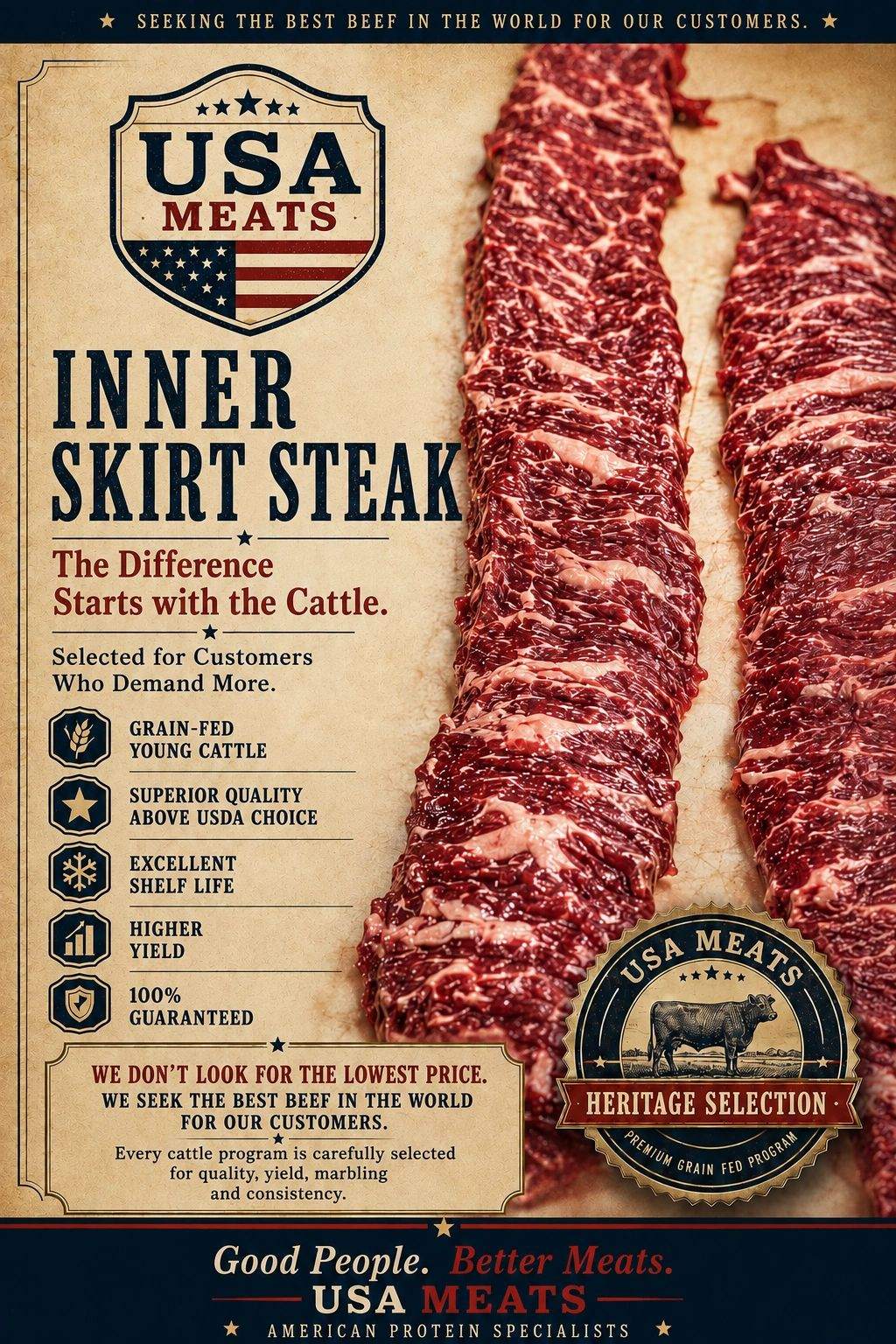
It depends on the program. Outside skirt (IMPS 121C) is usually sold peeled or unpeeled; inside skirt (121D) is wider and flatter. For fajitas and arrachera, many buyers want the membrane peeled and a light fat trim; some customers ask for an untrimmed whole skirt to marinate. Name the skirt, the peel and the trim level when you order. Our Mexican beef board lists skirt items.
Lean point is a lab measurement. Ask for the stated lean point (such as 50s, 65s, 80s or 90s) on each trim and grind lot, and use those stated points when lots are blended. Our Trim & Grind board lists the lean points we carry.
Blue flecks in ground beef are usually scraps of USDA inspection-legend ink, a food-grade color FSIS allows on carcasses. Stamped fat should be trimmed before grinding; many flecks mean stamp trim went into the grind bin, a processor quality miss. If the pieces are hard, rubbery or plastic-like rather than dyed fat, stop using the product, keep the package and report it with the lot paperwork and to the USDA Meat and Poultry Hotline. Reject lots with foreign material and note it on the bill of lading.
Large users of ground beef often buy frozen beef trim by lean point and grind or blend it themselves, instead of buying finished ground beef. Our Trim & Grind board lists trim from 90CL to 65CL (CL is the chemical lean percentage), whether it is tested or untested, the pack (often 60 lb boxes), the pounds available and the shipping origin. Trim is priced per pound, FOB origin, in full pallets.
Start with the price per pound on the live board, then allow for trim and cooking loss, because a lower board price with a heavy loss can leave less usable product. Value cuts that buyers commonly use for tacos, carne picada and slicing include chuck roll, shoulder clod, sirloin tip (knuckle), inside round and bottom sirloin flap. Our Mexican meats board lists these boxed cuts by the pound for the month. Prices change, so check the board instead of relying on an old quote.
Picanha (top sirloin cap) is on our monthly Mexican meats board, boxed and priced per pound, delivered Midwest. We sell in full pallets, so a volume of about 70 lb every two weeks is usually better served by a local foodservice supplier. If your total weekly volume across beef items is larger, send the full list to sales@usameats.com and we will tell you what fits. In the Chicago area we can also build mixed pallets, with several items on one pallet, and mixed pallets are coming to more cities soon.
Yes. We supply beef variety meats such as tripe, tongue and cheek meat, along with boxed Mexican beef cuts, mostly by the full load. Many variety-meat loads are priced FOB the plant, and we can also quote them delivered to your ZIP code. Availability changes by plant and ship week, so email sales@usameats.com with the item, pack and volume for a current quote.
Start from the four primals: shoulder (Boston butt, IMPS 406, and picnic), loin, belly and leg (fresh ham). Then decide per primal: butts whole or split, chops or roasts from the loin, belly whole or sliced for bacon, ham fresh or cured. Restaurants that use mostly shoulders and bellies often buy those primals by the case instead of whole animals. Our pork board shows a delivered price by state.
The sirloin is the hip end of the pork loin. Most plants sell the loin whole or boneless (IMPS 410 is the bone-in loin), so the sirloin end usually goes into chops, cutlets or boneless loin rather than a roast. Whole-animal shops cut it because they break the loin themselves. Buyers who want sirloin roasts can ask for them as a specified cut on a quote.
The Boston butt is the upper shoulder. In custom processing it is often split into two roasts, or cut into shoulder steaks, so it fits smaller packages. That is a cutting choice, not a different cut. On wholesale orders, specify whole butts, bone-in or boneless, and the pack, so you get the format your counter or kitchen expects.
If you mostly use shoulders and bellies, buying those cuts by the case usually beats a half hog, because you only pay for the cuts you use and you don't have to handle the rest of the carcass. Our pork board lists butt, picnic, loin, spare rib, ham and belly, fresh in cryovac, in full pallets. Prices shown are Delivered Illinois. For other states, use the landed-cost calculator or ask sales. Alaska and Hawaii are quoted by sales.
Yes. USA Meats offers all pork cuts by the pallet. Our pork board lists carcass cutout, loin, butt, picnic, spare rib, ham and belly, fresh in cryovac. For cuts not listed on the board, such as back fat, skin or special trims, email sales@usameats.com with the spec, the pack and the pallets per week, and we will quote them. Specs are available on request.
In the USDA IMPS pork series, item 416 is whole spareribs (at least 11 ribs with their costal cartilages, and possibly part of the sternum). Item 416A, St. Louis style, is the same slab with the sternum, the lower costal cartilage and the attached lean removed, which leaves a squared, rectangular rack. The removed strip is item 416B, sold as rib tips or brisket bones. A pack labeled St. Louis ribs should show a row of parallel rib bones on the bone side; a soft piece that is mostly cartilage with one crosswise bone is rib tips or trim. Order by IMPS number and weight range (416A runs 2-3, 3-4 and 4 lb and up) so every case matches. Prices shown are Delivered Illinois. For other states, use the landed-cost calculator or ask sales. Alaska and Hawaii are quoted by sales.
Both come from the pork shoulder, IMPS item 403. The butt, item 406 (often called the Boston butt), is the upper part, with the skin and neck bones removed; boneless butt is item 406A. The picnic, item 405, is the lower part, separated from the butt by a cut just above the shoulder joint, and it keeps the arm and shank bones and the skin; boneless picnic is item 405A. A picnic bought from the butt case often surprises people with its knuckle and skin flap, but it makes good pulled pork. Because more of its weight is bone, skin and connective tissue, it yields less meat per pound purchased and takes longer to cook. Programs that need a steady yield usually specify bone-in or boneless butt. Specify the item number, bone-in or boneless, and the weight range. Our pork prices are shown as a delivered price by state.
A firm, bean-shaped, gray-pink nodule sitting in the fat of a pork shoulder is usually a lymph node, most often the one in front of the shoulder blade (the superficial cervical or prescapular node). It sits mostly in the whole shoulder and picnic, but part of it can stay on a butt depending on where the shoulder was split. It is a normal part of the animal, not a defect, but it is usually cut out because of its texture and flavor; lift it out with the tip of a clean knife. A pocket of pus or thick yellow-green material in a capsule is different: that is an abscess, often from an old injury or injection site. Federal inspection rules (9 CFR 311.14) require any part affected by an abscess, and any portion contaminated by pus, to be condemned. If one shows up on receiving or in prep, set the piece aside, photograph it next to the case label showing the plant number and pack date, and file a claim with the supplier rather than trimming around it and serving it. Our pork prices are shown as a delivered price by state.
It can be per pound, but only for buyers who use the whole mix. Hanging weight is not take-home weight: bone, fat and trim loss cut the packaged yield well below hanging weight, and much of what remains is ground beef and roasts rather than steaks. Restaurants and stores usually do better buying the specific cuts or primals they sell. Our landed-cost calculator shows a delivered price per pound.
Most meat is sold by catch weight: the price per pound is fixed, but the exact weight of each case or piece is not known until it is packed. The invoice uses the actual weight. On a wholesale load, we quote per pound and invoice the actual pounds shipped, so check the case weights on the packing list against the invoice.
Compare landed cost, not the case price: the delivered price per pound plus any freight, fuel surcharge or delivery fee, order and delivery minimums, split-case charges, and shorts and substitutions (fill rate). Ask each distributor to quote the same item number, grade and pack, delivered, for your top items by spend, and track the quotes for several weeks rather than judging one. Many operators keep a broadline distributor for dry goods, paper and chemicals and buy proteins from a meat specialist, where price swings and spec differences matter most. We quote delivered prices on beef, pork, chicken and seafood. Mixed pallets are available in the Chicago area now, with more cities coming soon.
USDA does not require quality or safety dates on meat or poultry. When a date is used, USDA FSIS treats the date as a quality date, not a safety date: a sell-by date tells the store how long to display the product, and a use-by or best-if-used-by date marks peak quality. FSIS does require a pack date on poultry products so lots can be traced. For fresh beef, pork and lamb steaks, chops and roasts, the federal cold storage chart gives 3 to 5 days in the refrigerator at 40°F or below, and 1 to 2 days for ground meat and fresh poultry. Vacuum-packed and modified-atmosphere product keeps its quality longer, so follow the packer's date. A roast that darkens in the refrigerator is still safe; that is oxidation. Spoilage shows up as an off odor or a sticky, tacky or slimy surface. Rotate stock first in, first out by pack date, and freeze what will not be used in time; frozen at 0°F, meat stays safe indefinitely. We quote beef by item number.
Woody breast (hard, firm breast meat) and white striping (white lines across the breast) are muscle conditions in fast-growing broilers. They are quality issues, not contamination. USDA FSIS instructs plants to trim any inflammatory tissue; breast meat with white striping alone is considered safe. Buyers with tight quality specs can ask for grading or select sizes on breast meat.
Yellow flecks are usually fat. Dark vessels or bruising are blood left in the tissue, which is a quality issue. Green or yellow-green spots can be bile staining or a deep bruise, which plants are supposed to trim. If the meat smells off, is slimy or was held warm, discard it. On receiving, reject cases with off odors or temperature abuse and note it on the bill of lading.
Wholesale wings are priced per pound and usually packed in 40 lb cases. Prices move with the season and with demand, so a case price from a few weeks ago may already be out of date. Our poultry board lists whole wings, wing portions and jumbo cut wings by the pound and is updated every week. Poultry is sold delivered, in full pallets, with a 5-pallet minimum.
Yes. Drums and jumbo drums in 40 lb cases are on our weekly poultry board, priced per pound, delivered, in full pallets with a 5-pallet minimum. A full truckload is about 20 pallets, or roughly 40,000 lb. Send the item, pallet count, delivery ZIP code and the date you need it to sales@usameats.com or use Request a pallet, and we will confirm a delivered price for your state.
Yes. Our weekly poultry board lists poultry variety items such as gizzards, livers, hearts and necks/backs, along with their pack sizes, for example 40 lb cases or 30 lb vacuum packs. Like all poultry, they are sold delivered, in full pallets, with a 5-pallet minimum. If you are building a full load, you can ask for several poultry items on one quote.
Some liquid in the package is normal. USDA FSIS calls the juice that seeps out of meat and poultry during shipping, storage and display weep or purge, and it collects in airtight and vacuum packages. Chilled chicken can also hold retained water from processing, and the amount must be declared on the label. Spoilage looks different: FSIS lists an off odor, a surface that is sticky or tacky to the touch, or slime as signs that meat or poultry should not be used, and color alone does not tell you either way. On receiving, check that refrigerated cases arrive at 41°F or below, as the FDA Food Code requires, and note any off odor or temperature abuse on the bill of lading. Store fresh chicken at 40°F or below, use it within 1 to 2 days or freeze it, and cook it to 165°F. We supply all cuts of all proteins, including chicken.
Pockets of yellow, cheesy material or scabbed areas under the skin are usually an inflammatory process (IP), often called cellulitis, which is an infection in the skin the bird had before processing. They look different from fat, which is soft and smooth, and from a bruise, which shows as red, purple or green discoloration. Federal poultry inspection rules (9 CFR 381.86) require any part affected by an inflammatory process to be condemned, and the whole carcass if the condition is widespread, so localized IP is supposed to be trimmed off at the plant. A spot that gets past the line is a defect, not a normal part of the bird. On receiving or in prep, set the affected birds aside, photograph them next to the case label showing the plant number and pack date, and file a claim with the supplier rather than serving the affected part. If the product also smells off or feels slimy, discard it. We supply all cuts of all proteins, including chicken.
Some purge (liquid released from the fish) is normal, and salmon purge is often orange from the flesh pigment. A loose or broken vacuum seal is the bigger concern because it exposes the fish to air. Fish should smell clean and briny, not sour or ammonia-like. Keep fish at 40°F or below, or frozen at 0°F, and reject packs that arrive warm or with broken seals.
Per USDA FSIS, food kept frozen at 0°F stays safe indefinitely; quality is what declines, as freezer burn or color loss. Meat thawed in the refrigerator can be refrozen. Perishables left out more than 2 hours (1 hour above 90°F) should be discarded. Mold or unusual growth on frozen fish means the package was temperature-abused at some point, so throw it out.
Shrimp counts are the number of shrimp per pound: 21/25 means 21 to 25 shrimp per pound, so lower numbers mean bigger shrimp. Also specify peeled or shell-on, tail-on or tail-off, deveined, raw or cooked, and whether you want shrimp without added moisture-retaining treatments. Our seafood board lists counts and pack.
Wild salmon color depends on the species and its diet. Sockeye is naturally deep red. Frozen-at-sea or quickly frozen fish keeps color best; fish that is thawed and refrozen, or stored long without good glazing, can fade. Ask for species, catch method and freeze date when you buy, and keep frozen fish at 0°F or below.
Frozen seafood ships well inland as long as it stays at 0°F or colder in a reefer truck. Our weekly seafood board lists raw and cooked shrimp by count size, and tilapia fillets, in 10 lb and 20 lb cases, priced FOB Midwest. You can arrange your own freight, or ask us to quote delivery to your ZIP code. We offer all seafood items, so for anything not listed on the board, email sales@usameats.com with the item, form and volume and we will quote it.
A delivery is not complete until a named manager signs for it after checking case count, seals and product temperature. Fresh meat should arrive at 40°F or below (frozen at 0°F or below). Cases left unattended in a stairwell, dock or hallway overnight are a cold-chain and liability problem: quarantine or refuse them, photograph the labels, pack dates, lot codes and a probe reading, and document the drop on the bill of lading before anyone signs. Put receiving rules in writing (who may sign, signature required, no drop-and-go, temp checks). Claim credit or a replacement with the case paperwork. We quote rib and loin items by IMPS number (for example 109 roast-ready rib or 189A full tenderloin) and ship with scheduled, signed delivery so the quote, the pick ticket and the cases match.
Start with three or four steaks customers already know and order each one by IMPS number, grade or program, and portion weight: ribeye (112A ribeye roll, or 1112A portion steaks), New York strip (180 strip loin, or 1180 steaks), filet (189A or 190 tenderloin, or 1190-series steaks) and a value steak such as top sirloin (184 top sirloin butt, or 1184 steaks). Portion-cut steaks give the same ounces on every plate; cutting subprimals in-house gives more flexibility but adds labor and trim to manage, and the trim can go into steak sandwiches or bowls. Lock the grade on the spec so the menu description stays true. For delivery, keep hot food at 135°F or above until it leaves (FDA Food Code). We quote ribeye, strip, tenderloin and sirloin by item number and pack so the menu cost stays consistent week to week.
No. FDA advises taking frozen reduced-oxygen-packaged (vacuum-packed) fish out of the package before thawing it in the refrigerator, or immediately before thawing it under cold running water. Clostridium botulinum type E, which is associated with fish, can grow and form toxin at refrigerator temperatures when oxygen is excluded. Keep the fish frozen until use and follow any thaw instructions on the label. Vacuum-packed beef, pork and chicken do not carry this fish-specific warning: per USDA FSIS they can thaw in the refrigerator, or in cold water in a leak-proof package with the water changed every 30 minutes. Never thaw at room temperature. We supply frozen seafood along with all cuts of beef, pork and chicken.
It can. Catfish fillets often carry a band of darker, reddish muscle and fat just under the skin, sometimes called the mud line, that can keep a pink tint after cooking. Color is not a reliable doneness test for meat or seafood. The FDA Food Code standard for fish is 145°F for 15 seconds in all parts of the piece, and consumer guidance is 145°F, or flesh that is opaque and flakes easily with a fork. Probe the thickest part of several pieces from each batch and log the readings, so a guest's question can be answered with a number. If the center is still translucent or below temperature, it goes back. Trimming the dark strip at prep gives a milder, whiter fillet. Catfish is inspected by USDA FSIS, the same agency that inspects beef, pork and poultry. We supply frozen seafood along with all cuts of beef, pork and chicken.
Under the FDA Food Code, hot-held foods must stay at 135°F or above, and cold-held foods at 41°F or below. Cooking proteins in small batches close to service, holding them in a heated cabinet or steam well, and checking with a probe thermometer keeps them both safe and good. The health department that covers the operation enforces the Food Code version it adopted.
Decide the format first: raw tenderloins, raw breast cut in-house, or a par-fried frozen product. Then size the order to freezer space and weekly volume. Delivered pallet programs suit operators who can take full pallets; smaller operators often start with a distributor. Our poultry list is sold in full pallets, delivered, with a 5-pallet minimum.
Yes, if it is fully cooked the day before. USDA FSIS advises never to partially cook raw bacon and refrigerate it to finish later, because partial cooking does not destroy bacteria. Bake laid-out bacon on parchment-lined sheet pans until done but not fully crisp, cool it quickly and store it covered at 41°F or below. Before service, re-crisp it in a hot oven. Under the FDA Food Code, cooked and cooled food reheated for hot holding should reach 165°F within 2 hours and then hold at 135°F or above. Plan quantities on cooked yield: USDA labeling policy requires bacon sold as cooked bacon to yield no more than 40% of its raw weight, a useful guide to shrink. Laid-out or precooked bacon by the case cuts banquet labor. We supply all cuts of all proteins, including bacon for foodservice.
Most prime rib scrap comes from two places: trimming whole ribs in house before roasting, and end cuts and uneven slices after. Start with the spec. Buying a roast-ready rib (IMPS 109) or a boneless ribeye roll (IMPS 112A lip-on, or 112 with the lip off) moves most of the trimming to the packer, and IMPS sells each item in weight ranges, so you can pick a size that matches your portion and leaves fewer short pieces. Then put the ends to work as specials that sell at full price: French dip or hot beef sandwiches with au jus, prime rib hash at brunch, sliders, or steak salads. Raw fat and lean trimmed before roasting can go into a house burger blend, cooked to 160°F. For food safety, the FDA Food Code requires cooked beef to cool from 135°F to 70°F within 2 hours and to 41°F within 6 hours total, and sliced beef that was cooked and cooled must be reheated to 165°F before it goes into hot holding. We quote beef by item number.
Corned beef is usually cured brisket, though USDA FSIS notes it can also be made from rump or round. These are less tender cuts, so they need long, moist cooking. USDA does not recommend one method: a covered pan with liquid in the oven, a steam kettle or stovetop simmer, and a low-temperature cook-and-hold oven overnight all work. For safety, FSIS says to cook raw corned beef to at least 145°F internal and rest it for 3 minutes. Kitchens cook it well past that for tenderness, until it is fork-tender, and check with a probe thermometer. Pink color after cooking is normal, because the nitrite in the cure fixes the pigment. Rest it about 20 minutes, then slice across the grain. Hold it hot at 135°F or above, as the FDA Food Code requires. The flat gives even sandwich slices, while the fattier point suits hash or shredded beef. F09 covers how brisket is trimmed for corning. We quote beef by item number.
Public market desk
Weekday market briefs, USDA chart hooks, and a seasonal meat calendar. Figures come from USDA AMS and the USA Meats live boards.
Advertised retail prices by cut and region, with a week archive. These are not USA Meats sell prices.
Today’s brief · USDA Oct 26, 2026Boxed beef opens the week higher; every Choice primal finishes up
Weekly Choice, Select, and pork composite cutouts are in USDA cutout history. Pork is a weekly trend of completed weeks. Figures are USDA AMS, FOB plant, in dollars per hundredweight. They are not USA Meats sell prices.
Choice and Select include the latest published days. Pork is shown as a weekly trend of completed weeks, in dollars per hundredweight. These are not USA Meats sell prices.
Charts update when USDA close data is published.
Seasonal demand moments for wholesale planning. Timing notes only — live prices stay on the boards.
Loading the seasonal calendar…
USDA Market Pulse
Choice and Select are the daily cutouts. Pork is shown as a weekly trend. These USDA AMS figures are FOB plant, not USA Meats sell prices.
Source: USDA AMS, FOB plant.
Loading the USDA market pulse…
Simple & Fast
Send the product, cut, pack, grade, estimated volume, delivery ZIP code and timing.
We match your requirements through trusted partner plants and established distribution networks.
Approve pricing and availability, then we coordinate the cold-chain delivery details.
Nationwide
USA Meats supplies wholesale buyers across the United States. Terms vary by product, see each board. Full pallets only. Poultry minimum is 5 full pallets, delivered.
Prices shown are Delivered Illinois. For other states, use the landed-cost calculator or ask sales. Alaska and Hawaii are quoted by sales.
Delivered · full pallets · 5-pallet minimum
FOB Midwest
FOB origin
Delivered Midwest
Terms are on each deal card.
FOB Laredo for buyers arranging their own freight.
Shipping elsewhere in the United States is available on request. Freight is quoted per order.
Terms vary by product, see each board.
Our Approach
USA Meats stays lean—without costly warehouses, unused trucks or bloated inventory. That keeps the focus on responsive service, dependable cold-chain execution and competitive sourcing.
We move meat and seafood through trusted partner plants and long-standing distribution networks built over years of reliable service.
No costly warehouses, unused trucks or bloated inventory.
Commodity, premium and specialty items to specification.
Dependable cold-chain execution and delivery coordination.
Quick answers by email, WhatsApp or phone.
Who We Serve
Restaurants, hospitality groups and institutional kitchens sourcing dependable protein programs.
Regional buyers sourcing commodity, premium and specialty items to specification.
Retailers, meat markets and processors needing reliable cuts, packs, grades and programs.
What We Supply
From everyday staples to specialty programs, we source proteins around your specifications, volume and delivery needs.

The full range of USDA/NAMP beef and pork items—from commodity cuts to premium and specialty programs.

Shrimp and tilapia sourced directly through trusted partner plants for consistent quality and manufacturer-direct pricing.

Need a specific cut, pack, grade or program? Tell us what is on your list and our network will go to work.
Quality You Can See
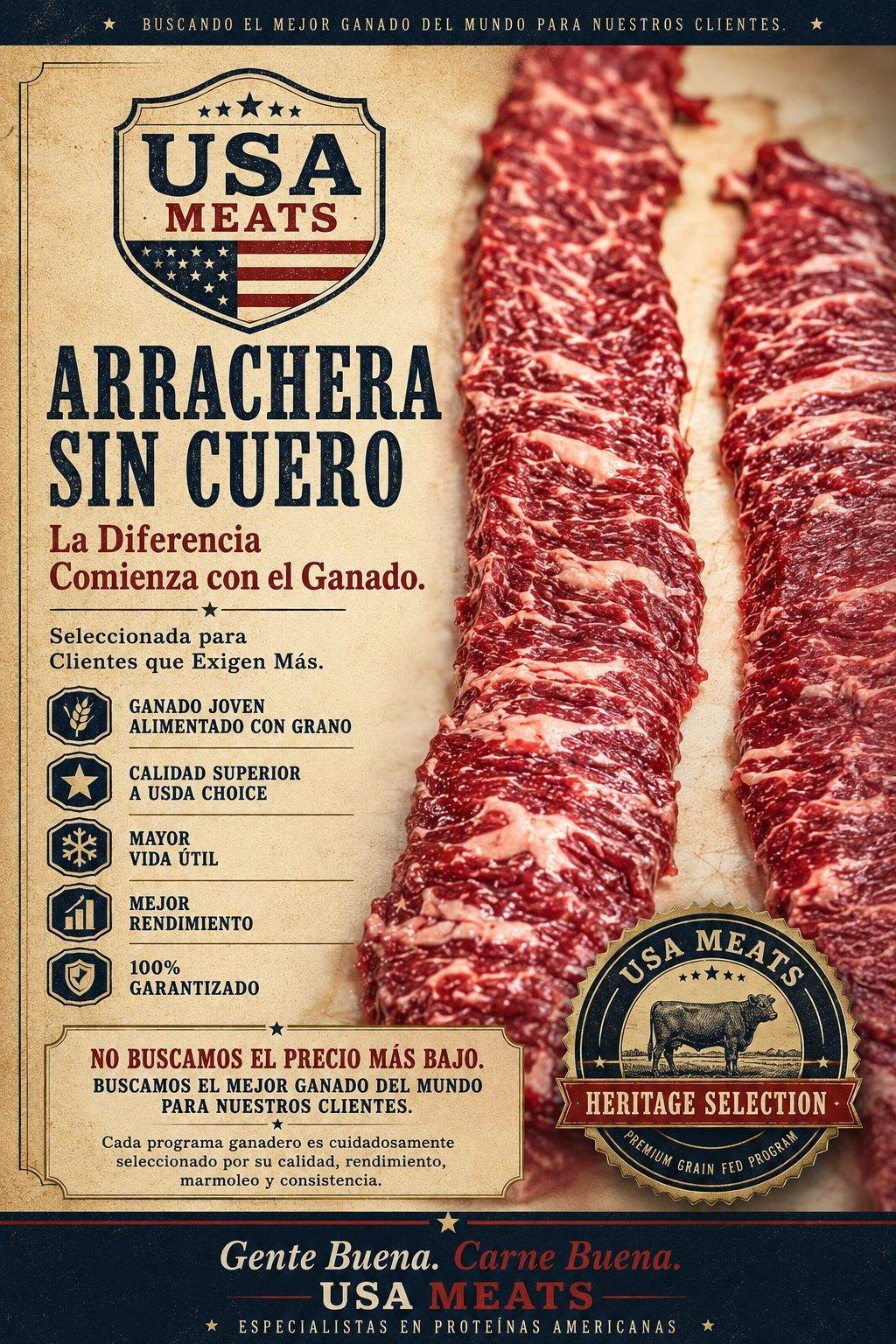
Inner skirt steak for foodservice and wholesale buyers. Request specifications, availability and pricing.
“We don’t look for the lowest price. We seek the best beef in the world for our customers.”
Credit Terms
Ready to establish credit terms? Download and complete the application, then return it to sales@usameats.com for review.
Contact Sales
Email sales@usameats.com for product availability and wholesale quotes.
Receive sourcing updates, featured programs and timely wholesale opportunities from USA Meats.
Nationwide
Estimate a delivered price from the live boards. Published lanes only. Estimate, confirm with sales.
Default 2,000 lb per pallet. Edit if this product packs differently.
Full truckload is 20 pallets, about 40,000 lb.
Choose a product, pallets, and a destination state or ZIP.
Current Wholesale Offers
Loading today’s offers…
Individually weighed, priced and labeled retail cuts in vacuum skin packs, ready for the case. Angus, Hereford and American Wagyu. Less backroom labor, longer shelf life, and a clean presentation.
$6.99/lb Delivered Midwest
About 20,000 lb arriving January 2027
Prices subject to availability, volume, and confirmation.
Ask About Volume PricingWeekly Seafood Price List
Weekly seafood price list, per lb, FOB Midwest. Raw and cooked shrimp and tilapia fillets in case packs.
Loading this week’s seafood prices…
Prices are per lb, FOB Midwest, and subject to change and availability.
Ask About Seafood VolumeFarm-direct shrimp, ordered by the load. ETA about 6 weeks from order. Prices confirmed when you order.
Loading farm shrimp prices…
Daily Pork List
Prices shown are Delivered Illinois. For other states, use the landed-cost calculator or ask sales. Alaska and Hawaii are quoted by sales. Full pallets only. Fresh, cryovac. Specs upon request. Prices update daily.
Loading today’s pork prices…
Prices shown are Delivered Illinois. For other states, use the landed-cost calculator or ask sales. Alaska and Hawaii are quoted by sales. Full pallets only. Fresh, cryovac. Specs upon request. Subject to availability.
Ask About Pork VolumeWeekly Poultry List
Weekly chicken price list, per lb, delivered. Full pallets, 5-pallet minimum. Prices update weekly.
Loading this week’s poultry prices…
Prices per lb, delivered. Full pallets · 5-pallet minimum. Subject to availability.
Ask About Poultry VolumeMonthly Price List
Monthly boxed beef cuts and variety meats, priced per lb, delivered Midwest. Valid October 1–31, 2026.
Loading the Mexican meats price list…
Prices per lb, delivered Midwest. Valid October 1–31, 2026. Subject to availability.
Ask About Mexican MeatsTrim & Grind
Frozen beef trim for grind programs, priced per lb, FOB origin. Chemical lean grades from 90CL to 65CL.
Loading Trim & Grind offers…
Prices are per lb, FOB origin, and subject to change and availability.
Ask About Trim VolumeWholesale Programs
Nationwide loads for foodservice, distributors, and retail. The price per pound stays on the live board. Use the form to request a pallet or a full load.
Chicken leg quarters and other poultry dark meat are listed on the weekly poultry board. That list is delivered, full pallets, with a 5-pallet minimum. The published price per pound is on the board.
Tell sales the pack and how many pallets you need, plus the delivery ZIP and the date. Freight is confirmed with the quote.
Inner skirt is offered to wholesale buyers nationwide. When a load is featured, it leads Today’s Wholesale Deals. The current price per pound and the terms are on that board.
Request a pallet or a full load, or open the Heritage section for the product flyer and specifications.
USA Meats supplies boxed Mexican beef cuts and variety meats to wholesale buyers nationwide. Midwest delivery and the price per pound are on the monthly Mexican meats board, along with the dates that list is valid.
Send the cut, the pack, and your delivery ZIP. The quote uses the published list.
Fresh pork, cryovac, by the full pallet. Prices shown are Delivered Illinois. For other states, use the landed-cost calculator or ask sales. Alaska and Hawaii are quoted by sales.
Request the cut and the number of pallets or a full load. Include the delivery ZIP and the date you need it. Freight is quoted with the order.
21/25 count shrimp is offered to foodservice and distributors nationwide. Pack, availability, and the published price per pound are on the seafood price board and, when a 21/25 item is listed, in Today’s Wholesale Deals.
Those boards are the price. Request a pallet with the count, the pack, and your delivery ZIP.
